Показаны сообщения с ярлыком signals. Показать все сообщения

понедельник, 13 февраля 2012 г.

PSK: VDL-2 (VHF) - AirSystem, PSK-8, Br - 10500

VDL-2 (VHF)
AirSystem, PSK-8, Br - 10500

Author: SergUA6 
Band Width ~17000 Hz
Baud Rate 10500 Hz
n-Ary (PSK/MPSK) PSK-8
RX mode source I/Q record


Sonograms:

pic.1 General view


pic.2 Manipulation speed


Pictures
pic.3 Phase constellation


VDL-2 - It is rather new and the perspective view of aviation telecommunication (ATN). It is very actively introduced in practice. It is provided step-by-step change/move from the previous generation of similar system ACARS, to the new VDL-2, VDL-3. As well as in ACARS, data exchange between aircrafts and the earth occurs by extremely short packages. In average, lenght of the package is about 20-40 мс, but it can be both shorter and longer packages. In comparison with ACARS, the throughput of channel ATN in VDL-2 is essentialy increased from 2400 bps (ACARS) to ~31500 bps.


As a whole, at appropriate quality, the signal is confidently enough analyzed and identified, there are no obvious features detected.

вторник, 21 июня 2011 г.

SECAM - National standard of Russian TV

Full TV spectrum, with NICAM (digital audio channel)
SECAM - National standard of  Russian TV 


Author: SergUA6 
Band Width ~ 7 mHz
RX mode Source I/Q record

The signal is here. Send by geka. The file size is about 10 Mb.

Sonograms:

pic.1 General view


pic.2 The detalization


pic.3 The graphical spectrum


Diagrams:

pic.4 NICAM - digital channel of sound


Pictures:

pic.5 Channel of the brightness after AM detector in VMW 


SECAM - National standard of Russian TV - The television standard of Russia. Standard SECAM is well described in the literature, so there is no special sence to stop on it. The interest represents an additional digital sound channel by technology NICAM, in which modulation  PSK-4 (QPSK) is used. This additional channel, is allocated apparently from screenshots, between chrominance subcarriers and the main analog channel of the soundtrack.


воскресенье, 12 декабря 2010 г.

PSK: CIS-3000

CIS-3000
PSK-8, Br-3000.
PSK


Author: SergUA6
Band Width ~3400 Hz
Low Range ~600 Hz, in this example only!
Baud Rate 3000 Hz
n-Ary (PSK/MPSK) PSK-8
Carrier frequency ~2313 Hz, in this example only!
ACF Preamble ~ 85 ms
RX mode SSB


Sonograms
pic.1 Generall view

pic.2 General structure of the signal

Diagrams:

pic.3 8th harmonic

Pictures:

pic. 4 Phase constellation


pic.5 ACF preambles


CIS-3000 - With very high probability this signal has the Russian origin roots. More and more often there are signals which are leaving the limits of standard phone channel. This signal represents that kind of signals. The spectrum of this signal occupies 3400 Hertz. The maximum technical speed 3*3000 = 9000 bps.

воскресенье, 28 ноября 2010 г.

MFSK: WinMor

WinMor, mode 2*MFSK-4
Amateur's mode. Br - 46.875


Author: SergUA6
Band Width ~500 Hz
Baud Rate 46.875 Hz
Count of Carriers 4 in one group and 4 in second group
Step between carriers 46.875 in group, 93.75 between groups Hz
RX mode SSB

Sonograms:
pic.1 General view


pic.2 Detaltization. Two groups of MFSK-4

pic.3 Detalization of the groups. Space between the groups.

Diagrams:
pic. 4 Start

pic.5 Start detalization

Pictures:
pic.6 Graphic spectrum of the signal


WinMor, mode 2*MFSK-4 - it is the new amateure mode (atleast it is announced in 2010 year), which had been created by radio amateurs. The protocol has a lot of transmission formats. In the current example of the signal, two MFSK-4 channeles are used. The signal is bright enough, so there shouldn't be problems with it's identification.

суббота, 6 ноября 2010 г.

SATCOM Satellite, US INTEL - 260.41, UHF (B)PSK-2, Br - 260.41

SATCOM Satellite, US INTEL - 260.41, UHF
(B)PSK-2, Br - 260.41


Author: SergUA6
Band Width ~520 Hz
Baud Rate 260.47 Hz in this example, exact value 260.41
n-Ary (PSK/MPSK) (B)PSK-2
ACF ~1900 ms preamble, ~368 ms data/message
RX mode SSB

Sonograms:
pic.1 General view

Diagrams:
pic.2 General structure of the signal

pic.3 Phase constellation

Illustrations:
pic.4 ACF


SATCOM Satellite, US INTEL - 260.41, UHF - is the very wide spread signal, which can be met in the channeles of satellite group SATCOM. This signal is encrypted.

понедельник, 27 сентября 2010 г.

FSK: "Avaris" - domestic(Russia) system of special communication on VHF

"Avaris" - special-radio service(VHF), FM-GFSK, Br-9600.

Author: SergUA6
Band Width ~12000 Hz
Baud Rate 9600 Hz
RX mode Source I/Q record


Sonograms:

pic.1 General view


Diagrams:

pic.2 Signals demodulation

Pictures:


pic.3 General structure of the signal


"Avaris" - domestic(Russia) system of special communication. In a basis of this system, lies using of special repeaters under similar mark "Avaris". Repeaters provide expect the basic functions, also functions of recording coded/encrypted speech messages and their subsequent transfer to concrete addressees or group of users. In this system, and not only in this, speech is digitized by means of the delta modulation. The received digital stream is ciphered and transferred, in this case, GFSK modulation is used.


суббота, 18 сентября 2010 г.

MFSK: NEXEDGE

NEXEDGE
NXDN - 4800, 2400. C4FM, BW ~ 10000 Hz, 5000 Hz


Author: SergUA6
Band Width ~10000 or 5000 Hz
Baud Rate 4800 or 2400 Hz
n-Ary (PSK/MPSK) C4FM
Count of Carriers 4
ACF ~ 80, ~ 40 ms
RX mode Source IF record

Sonograms:

pic.1 General veiw NXDN with speed 4800

pic.2 Generalview NXDN with speed 2400

Diagrams:

pic.3 Manipulation speed 4800

pic.4 Manipulation speed 2400

Pictures:

pic.5 Sub-optimum demodulation 4800

pic.6 Sub-optimum demodulation 2400

pic.7 ACF NXDN in 2400 mode, only 80 ms

NEXEDGE - is the communication system using NXDN protocol. NXDN is the joint development Kenwood and ICOM companies. The protocol is declared as opened one, modulation which is used on VHF, is the classical C4FM. The Same type of modulation is also used in the other
known communication system APCO-25 on the basis of standard P-25.

On it similarity comes to an end, P-25 and NXDN are incompatible.

As a whole, the signal is easily identified, especially in SA last versions: there are special possibilities, for confident enough identification C4FM. Two variants of the signal are prepresented on the records: broadband, under the standard channel by a strip/band 12.5 kHz, and narrow-band under the channel 6.25 Khz. The maximum technical speed accordingly in a broadband mode 9600 bps, in narrow-band 4800 bps. Thus clock frequency of manipulation for C4FM turns out twice less, 4800 Hz and 2400 Hz.


пятница, 3 сентября 2010 г.

OFDM, COFDM: CIS-59, Known as the "Ferrite", perhaps an experimental(inner) brand.

CIS-59, Known as "Ferrite", perhaps an experimental(inner) brand.
Ch-59, Br-40 Hz, Sh-50 Hz, QAM-64, k = 1/4 = 0.25


Author: SergUA6
Band Width ~3000 Hz
Low Range ~330 Hz
Baud Rate 40 Hz
n-Ary (PSK/MPSK) QAM-64
Count of Carriers 59
Step between carriers 50 Hz
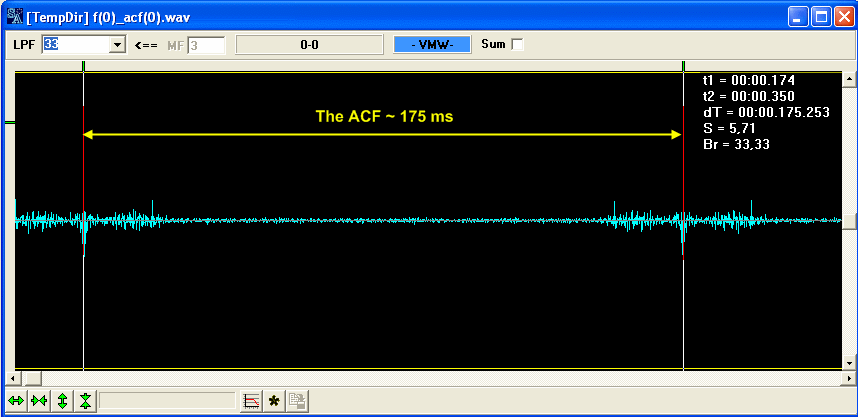
ACF ~175 ms
RX mode SSB

Sonograms

pic.1 Generall view

Diagrams
pic.2 Phase constellation in the channel

pic.3 Synchronization symbols (every 7th symbol)

Pictures
pic.4 ACF

CIS-59 "Ferrite" - The name "Ferrite" quite possibly is not wide known. We can suppose it is an internal trade mark of the manufacturer. The manufacturer is unknown (at least to me), but it is known that it is domestic (Russian) development . The record has an exellent quality, all parameters are easily defined in SA.

I would like to mark some features of this signal, these are:
  1. special symbols the synchronization/adaptations (every seventh symbol).
  2. the form of constellation QAM-64 is characteristic more likely for NATO signals, than for signals CIS.

The maximum technical speed = 59 (quantity channels) *40 (clock frequency of manipulation) *6 (quantity of bits in one position QAM-64) minus synchronization symbols, that makes 14160 - (14160/7) ~ approximately 12137 bps.

The signal is generated by A model.

The detailed information about models/types of OFDM is in article/update version SA update to version 6.1.2.7 & OCG update to version 1.0.2.7


пятница, 13 августа 2010 г.

Super DARN- is the interesting signal from UDXF discussion.

After some discussions, it became known, that the mysterious signal, about which we were spoken about in previous post is Super DARN (Finland).
Here is some details about this signal:

Super DARN
Author: SergUA6
Band Width ~5900-6000 Hz
Low Range hopping
RX mode source IF record

Sonograms:

pic.1 Generall view
pic.2 Detalization
pic.3 Detalization

Super DARN - there is developed enough international network for studying of an upper atmosphere and an ionosphere (Super Dual Auroral Radar Network) regions. The signal of one of radar of this network is represented in this case. The signal is curious enough, as possesses rather narrow spectrum of radiation, that is not characteristic for various probing systems. As a rule, spectrum's width of such systems, is located 20-80 kHz and higher limits. In generall, the measured parametres have relative/conditional character as can vary depending on tasks.

Many thanks to Leif Dehio for help with identification of the signal.

понедельник, 9 августа 2010 г.

An interesting signal from UDXF conference discussion.


The very interesting signal, which record has been represented by Mike, appeared in UDXF conference.
The record itself, is ~2 minute I/Q file, with capacity 16 bits, the size of the file is nearby 80-90 mbyte.
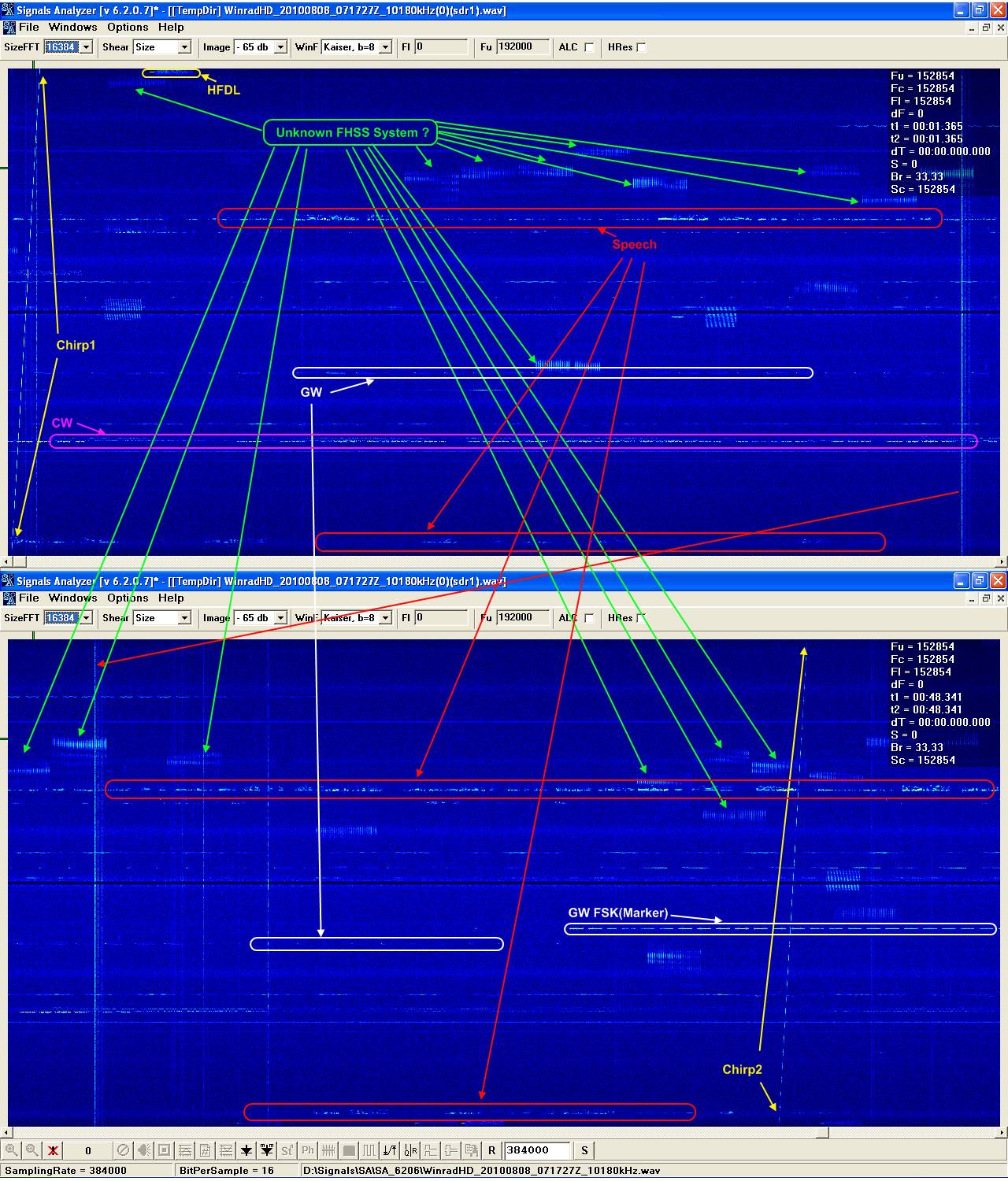
Actually, there are many various signals in this record, we have marked some on the general spectrogram.

General view.


Presence of two chirps seemed very interesting to us. That has allowed to measure key parametres and to find out some curious nuances.


There is an interesting gaps(breaks), in the same positions, on two independent chirps.

In generall, the basic interest, certainly represents, not absolutely clear/understandable system, which is well visible on this spectrogram and designated on the general sonogram by green colour.

Unfortunately, on this record, it is impossible to tell precisely what width of a spectrum has this signal. Presumably it can be about 20 kHz. Nevertheless, it is well visible, that the signal has FHSS signs. It is also rather not difficult to receive key/basic parameters. It is well visible that the nature of impulses, practically in all bursts, is absolutely identical. That is strange enough, if the system is intended for real information transfer.

We are still have difficulty to classify this signal. Firstly, there is not enough data - the only one record. In the second, we didn't have similar records before. Besides, the subject of interest has too blurred limits(boundaries) and relatively weak level, plus it is liable to considerable selective fadings.

At the conference, also the other signal is discussed. The parameters of this signal, differ from the first signal, but both these signals have similar impulse nature, and close structure (an alternation of the small identical bursts). Probably, there are a lot of such signals in the air, all these signals can be different, but they are very interesting signals observe to.