Показаны сообщения с ярлыком SA update. Показать все сообщения

понедельник, 5 марта 2012 г.

SA Update to version v 6.2.6.7: two monitors

SA Update to version v 6.2.6.7

This is planned update.

Correct work of SA in the systems with two and more monitors is realized In this update.


Minor errors has been eliminated.

~Good Luck

среда, 25 января 2012 г.

SA update to version v 6.2.6.5

SA update to version v 6.2.6.5 
Planned update. 

In this update, possibility of resample and shift of the signals on fractional values of frequencies is added. 


Perhaps more important part of current updating, is the first stage of integration in SA calculator K. 


The first stage doesn't mean the high-grade calculator. At this stage, in SA the mainframe of preliminary processing, so-called preprocessing is integrated. The primary goals of this block, gathering of primary parameters of the signal, and preliminary rough processing of this data. 


 The list from the most probable values "Magic K" which detailed analysis will be spent in the second part of the calculator which integration is planned further will be result of work the pre-processing block. 

Nevertheless, even in such, very strongly simplified kind, it is already possible to receive authentic enough values K on some signals. 

That is much better, than absolutely nothing.As work with the calculator means some knowledge of main principles of its action, and some specific skills, the article concerning calculator use in practice has been written. Also some separate moments and problems of getting authentic values K ==> Analysis OFDM with CP in SA versions 6.2.6.5 - a pre-processor of calculator K. 

As usual, in this version some minor errors found out by users SA are eliminated, and small changes are added in some modules and blocks. 

Good luck~


воскресенье, 6 ноября 2011 г.

SA update to version v 6.2.6.4: Visualization improvement.

SA Update to version v 6.2.6.4.
The planned SA update.

The error, which has been found out by users is fixed: At the opening of stereo files with wav tag, which differs from 1 and 3, the program was going into "deep dream". 

Also the displayment of the expanded information about the codec, which is applied in a current wav file is added. I specify, that it is not type of codec which the program supports it, it is the codec title, which is used in the current wav file. Sometimes it allows to communicate with suppliers of records/signals more in detail.


Visual displayment of the  constellations and transitions in them is increased in phase viewer , at least visually, the new format looks much more attractive than the old. 

Also, as always, the number of minor bugs is fixed.

пятница, 30 сентября 2011 г.

SA update to versionv 6.2.6.3

SA update to version v 6.2.6.3 

This is the planned SA update.

In this version support of Drag-and-Drop function is added.


The function of detection/determinition of the offset modes of the phase manipulation is introduced in the Phase viewer. 


It is necessary to show certain care, as any automatic system of identification, this function can be mistaken, especially on the signals, which are damaged by various distortions. Nevertheless in some cases, the presence of this automatization is justified. 


Also a number of minor errors found out by users is corrected.

~ Good Luck

понедельник, 22 августа 2011 г.

Update SA to version 6.2.6.0

Update SA to version 6.2.6.0

This is planned update SA.

Added possibility insert the saved path to the file/directory. This is really handy because sometimes a very long way, and clicking on directories rather tedious, easier to insert from the clipboard.


Added the possibility of fast increase in the desired part of the signal in the WF module. Fragment between V-markers scaled over the entire window.


Function of oversampling uses parallel computing, in general, it increases the speed and quality.
 

Quality resampling improved by revising the algorithm and its optimization.

The examples old and current solutions.


Extreme caution should be taken with to any external processing program. As minimum all need thorough inspection and testing, otherwise You may experience various unpleasant incidents, such as this one.


SA provides accuracy of 1 Hz resampling at sampling rates up to 100 MHz.

In fact, precision in 1 Hz is not a fundamental limitation, and the internal procedures of SA uses precision oversampling in fractional values SR, if needs.

In the OFDM module, function of "Find CT" also uses parallel computing.
 
As well as the usual fixed various minor problems.

Good Luck.

вторник, 2 августа 2011 г.

Update SA to the version v 6.2.5.8 : implementing technology of parallel computings

Update SA to the version v 6.2.5.8 

Planned SA update. 

At the desire of users, in this version support of 8bit data in unsigned and signed formats is added. The unsigned format is typical for the standard wav files, signed format for the various exterior devices, programs and calculators. 


Also, since this version, we are implementing technology of parallel computings. It allows to double, quadruple etc. speed of the main operations, depending on an amount of cores in the processor. 


The maximum quantity of CPU cores supported by SA is equal 8, it is not the principle limitation, simply we have considered that it will be enough for beginning , and if composition CPU includes 16 cores or more, SA won't use all of them, but SA will try to involve all accessible cores to 8 inclusively. 


On the current moment, the functions of the main working window are already parallelized. The screenshot above, shows: 


- Red color - means already parallelized operations 
- Green color - means not parallelized operations, but very strongly optimized 
- Not selected by any colour - means it is left "as is" yet. 


It is the initial stage of increasing of SA computing power, further gradually, we will translate/turn whenever possible, all functions of the program in this parallel mode. 


Though this version already had preliminary and careful beta testing, some errors are still possible, which will be corrected in the process of their detection. 


Good Luck~

суббота, 23 июля 2011 г.

Updating SA to the version v 6.2.5.4.

Updating SA to the version v 6.2.5.4.

This is planned update SA. We had added function of inversion of the whole spectrum at once. This function, in difference from regular procedure, works much more quickly. Very often similar problems arise at the analysis of various I/Q (SDR) records.


At coincidence/combination of H-markers and a call of the regular procedure of in-band inversion, the special case of fast inversion of the whole spectrum is working.


 ***
 two popular enough in analysis functions ACF and CCF are introduced into module WF. Basically, it duplicates similar decisions in the basic working window, but for the module of the form of a signal, this opportunity is far not superfluous.


Please pay attention, that the result of ACF function is displayed in the new window.


The result of function CCF is mapped in the same window, whence the function has been caused. Thus, the basic signal is mapped as a background, and the working element of the window is function CCF, its graphic is scaled, displaced, etc. the Segment/fragment of a signal, which is chosen as example for calculation CCF, is painted in yellow color.


*** 
The work with long symbols (up to 32000 samples (LS) and higher) is provided in module OFDM. The previous versions had restriction in 9000-10000 samples. However, it is necessary to notice, that analysis of OFDM signals with such sizes LS (~ 16000-20000 samples), demands certain, sometimes essential expenses of time.


As usual, a number of internal small (sometimes even funny) bugs, which had been found out by users are eliminated. To a category of the "funny bugs", we bringh a recent turn of image CT, in this version all is returned on former positions.:-) actually, both variants are correct. But as, the left part at us has been proved as "good" in one of early SA articles - "work with module OFDM, FFT spectrum", we decided to return to a former format of CT display.

Good Luck ~

воскресенье, 26 июня 2011 г.

SA update to the version 6.2.5.3

SA update to the version v 6.2.5.2/3 

Current update though doesn't affect the main SA possibilities, nevertheless solves a range of problems. 

The first and bad enough problem, is connected with imaging/mapping of the correlative triangle (CT) in OFDM module. I underline only with imaging. 

At the usual revision of the algorithms and their decisions, mathematic had confused us with the news, that the correlative triangle left side can't be good/correct/rightly, as there is no general root at words "rightly" and "left". :-) 

The joke had been estimated, but nevertheless, really, at the very early beginning of OFDM module development, an output of image CT on the screen was unrolled/turn on 180 degrees concerning a vertical axis. And the right (good/correct/rightly) side CT has appeared on the monitor as the left side. As it doesn't influence results of operation of the algorithm, the error in display wasn't so noticable and had been existing long time enough. 

In this version we recover justice as it doesn't demand any fundamental changes in the main mathematical calculations. 


Actually such awkward situation is gross enough error, although it doesn't influence the general results. 
*** 
We remove historically added restrictions on the lower bound of filters in WF module and the general-purpose/universal demodulator. In the current version the general approach to a filtration is reconsidered, and the range of setting of frequency of a cutoff of filters is accepted from 1 to Fd/2 a Hertz. 


It allows to solve, in some cases, the analysis tasks more effectively. 


*** 
It is possible to set any, in limits from 1 to 1000 level/step of time gating in VMW module, at the usage of a stroboscopic output of the image, in this version. 


It as expands VMW module possibilities to the better side. 


*** 
The error in ISD corrector operation is eliminated, we were informed about this error by users. The corrector incorrectly worked in many cases, it had been connected with update of the algorithm of correction in version 6.2.4.6 the Error was thin enough, and to find it out casually was rather problematic: that once again shows, that users are very attentive and skilled in analysis questions. 


In this version, besides bug fixing, speed of ISD corrector operation ISD was increased approximately in one and a half-two time, and its efficiency is raised. Thus as before, the algorithm isn't omnipotent, but it is general-purpose/universal, and it still can be mistaken, but in the majority of practical cases, it is well enough compensates various, not fatal distortions of signals. 


*** 


In all previous versions, attempt to load the files with big size and big sampling rate in VMW module, leaded to an exceptional situation (error). Sampling rate reduction In some cases helps, but in general, it does not solve the problem. In version 6.2.5.3 this moment is corrected. 


Record-example the size of record ~ 10 mbytes. 


*** 


Also possibility to synthesize various MFSK signals has been added into OCG programm, al though it doesn't affect SA, nevertheless, we recieved requests to include this function into synthesizer, so we realized it it in version OCG 1.2.1.2 The result of synthesis of signal MFSK-11 is shown below. 


As usual, a range of small, hardly noticeable improvings had been done, and some minor problems were solved. 


Good Luck~

среда, 15 июня 2011 г.

SA update to version v 6.2.5.0/1

SA update to version v 6.2.5.0/1

Planned SA update.

Determination of an exact amount of frequencies in the various MFSK signals is an important enough task in the analysis. In this update we had added this possibility, we introduced function "Count freqs” into the module of viewer of the form(WF).


The function "Count freqs" calculations of the size of the grid of frequencies. I underline, not an amount of frequencies used/involved in a current fragment of a signal, but dimensionality of the grid, in which limits these frequencies are generated.

Basic actions on function "Count freqs" usage are the following:

1. To receive speed of manipulation of the signal - Baud rate, by any method. It is desirable, but not a mandatory step.

2. To select the signal by H-markers. This operation demands an accuracy. It is impossible to select the signal too densely, and it is impossible to select it too widely, the reasonable compromise is required. Normally we recommend to allocate the markers on distance within (1.5-3) *Br from the signal.

3. Call the Phase detector function. It is the standard operation, which creates the new window with results.

4. It is necessary to call WF module in the new window through PopUp menu, it is also the standard action. If in the first point value Baud rate has been received, in WF module, then the automatic filtration of the signal will be produced, otherwise the filtration will be necessary to realize in the manual mode.

5. It is necessary that all artifacts (usually it is the beginning and the end of a signal) have been displayed behind the display window in WF module. It is possible to reach, at least by two methods:
The first - to select a pure part of the signal with V-markers, and to create a copy in the new window.
The second - using horizontal zoom, and shifting/moving the signal by the horizontal slider, to bring in the artefacts behind the window borders.

6. To turn on the mapping of the histogram "Sum"=ON on the "pure" signal. To pick up the size of the histogram by vertical. To install H-markers on the upper and lower channel of the histogram. To cause PopUp menu of the module. Position of V-markers can be any as all visible part of the signal is processed.

7. To select point "Count freqs".

Important! The result of function "Count freqs" is not an amount of channels in the signal, but the size of the uniform/proportional grid of frequencies, in which the used channels are "laid down". The so-called grid of formation, the size of this grid represents big interest in the analysis.

Range of determination of dimensionality of the grid of frequencies by the function "Count freqs", is from 4 to approximately 260. In reality, the function defines grids of more dimensionalities to 300-320, but it very strongly depends on the signal quality, and many other things.

Error report appearance is possible.

The reasons/causes:

- Both H-markers, and-or one of them, are installed not on the histogram lines/channels

- There are lesser then 4 or more then 400 frequencies in the signal
- The distance between H-markers is too small, or the markers are combined
- the function can't be completed correctly at current parameters of the signal, or on the current fragment of the signal.

There is an article on usage of this new function, as there are some thin moments and nuances, which are beyond the update description =>
Signals Analysis in SA version v 6.2.5.1

It is necessary to show certain care, although function "Count freqs" works reliably enough in many cases, nevertheless, it is rigid enough algorithm which can be mistaken.


As usual, minor problems found out by users are removed. Also I want to express gratitude to all beta testers, who have taken part in preliminary testing of this update.


Good Luck~


понедельник, 23 мая 2011 г.

SA update to version 6.2.4.8


SA Update to version 6.2.4.8.

This is the planned update.

In this version we are expanded number of SA tools by adding "In-band signal inverse" function.


This function provides qualitative enough inversion of the selected band of a signal or the whole signal, without affecting the other spectrum. It is required for the fast inversion of the signal, and as allows to restore/compensate or reduce various distortions in some cases. 


Example of operation with the distorted signal Icom UT-109


Distorted fragment.
Restored fragment.


Also range of minor bugs detected by users had been removed, some small corrections had been added.


Good luck!

пятница, 15 апреля 2011 г.

Update SA to version 6.2.4.6

SA Update to version v 6.2.4.6

Support of 64 bit data with a floating point is added. 


The algorithm of operation of OFDM module had been essentially changed.

"One-dimensional" search of a correlative triangle(CT) which had been realized in the previous versions, possesses imperfection. The probability of detection/finding CT, depends on signal shift on/by frequency, and sometimes the algorithm is mistaken.

Problem is not in the fact that it happen rather rare, and in that, if the triangle hasn’t been found out there are no any warranties that the triangle really doesn't exist.

In the current version of OFDM module another algorithm of "two-dimensional" search (terminology belongs to our mathematic) is implemented. This algorithm provides much bigger guarantee of findings CT, and besides it has reserves for optimization. In spite of the fact that in the computing/calculating relation the new algorithm is much more resource-demanding than the previous one, the general speed of finding/detection CT, is increased in 6-7 and more times, especially it is noticeable on the big dimensionalities LS, for 600-800 samples and above


Possibility of relocation of the green marker through the keypad is added. It works only in a dynamic mode, as in the static mode there is no big sense to “walk” on channels.


Some utilitarian actions in OFDM module has been automatized, for example, in the current version the program tries to install CT in an optimal position independently. Accuracy of calculation of clock rate(Br) is increased.

Also work/operation of some separate functions and procedures is reconsidered/optimized both in OFDM module and in other modules.

As usual, except the described changes, a range of internal corrections is realized, errors found out by users has been fixed.

This update affects and changes a little bit the general scheme of actions at analysis OFDM. Though these changes are rather insignificant and directed on simplification of procedure of the analysis, nevertheless, we will provide the small article about an operation with the current version in the near future.  

Good Luck!


понедельник, 28 февраля 2011 г.

Update SA to the version v 6.2.4.2

Update SA to the version v 6.2.4.2

In this update the range of problems found out by users has been solved.


1. The rigid/hard restriction on data size for calculation ACF and CCF is introduced.
 
The matter is that due various reasons, at the call of ACF and CCF functions SA user can casually push "Ok" in a situation, when the user hadn't supposed to do it, or the user wanted to push "Cancel" instead "Ok", and the hand itself has pushed other button. :)
 
In this version such situations are eliminated. The maximum data size for operation of function ACF makes 70 mbytes. For CCF, the maximum size of a fragment is about 50 mbytes. If these restrictions for someone are essential, please inform us about it (e-mail us), and we will solve this question.


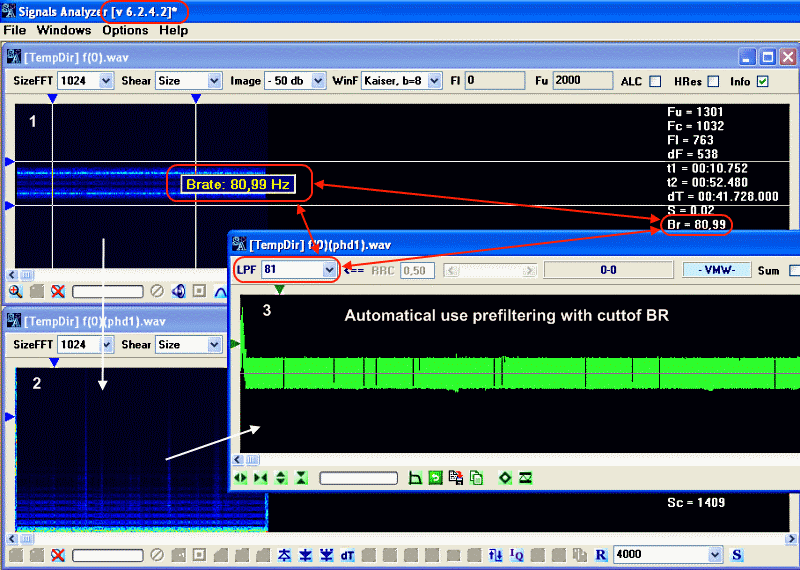
2. Very often, after the phase detector, the call of signals waveform module follows. In this version, if beforehand the value of clock frequency has been recieved by SA tools, then LPF filter is applied at once by default. Normally, in 99 % of cases, this is the standard action, which is just automated now.


As usual, except the described changes, a range of hardly noticeable, but important moments is fixed.


Good Luck!

воскресенье, 20 февраля 2011 г.

SA update to version v 6.2.3.8: Universal MFSK demodulator

SA update to version v 6.2.3.8

In this update, the pilot version of the general-purpose/universal demodulator MFSK is realized.


The demodulator supports to 256 levels (frequencies) of various MFSK signals. As an example: obtaining of a bit stream from the records Packet AX.25 and APCO-25 it is shown on the picture above. As FSK-2 it is special case of MFSK, the current extension of the module doesn't influence the previous possibilities, but only expands them.


Please pay attention on the allocation of levels of demodulation. The first and last levels, aren't restricted by the markers! Their area is stretched behind their limits, as it is shown below.


The bit stream can be presented in two variants.

The first variant is the symbol representation of levels recoded by default. In this case, the internal map of codings is used. 32 characters are supported standardly. It is favourable for using for FSK-2, MFSK-4,8,16 etc., that is, for rather few-channeled MFSK modes.

The second - obtaining/recieveing of the stream in the form of HEX-byte. Bytes in this case are partitioned/devided by the symbol-separator "x" (the Latin character "X" on the lower register).


As, the bit stream implies further processing anyway, we have refused an inverse mode. There is no big sense in an inverse mode, as an inverse can be received in any exterior viewer. Besides, we are planning to create our own special viewer of a bit streams.

Below you may view the practical example of operation of general-purpose/universal MFSK demodulator on the signal South African Navy.


Good luck!

суббота, 12 февраля 2011 г.

SA update to version v 6.2.3.6

SA update to version v 6.2.3.6

We have added a cross-correlation function (Cross-Correlation Funсtion- CCF) in this update.

In a difference from ACF, CCF function, in some cases, can provide more information about a signal or the selected fragment.


After CCF launching, the cross correlation of the selected fragment of a signal between V-markers and whole record is calculated. It is shown typical on the picture, and it is certainly far not just one example of CCF usage.

As it is not difficult to notice, the selected fragment, enters as a component into all units of the signal on the record, and the position of this part is precisely defined on peaks of CCF resmult. The maximum peak will correspond to position of an initial fragment, as correlation in this case is 100 %. It is problematic enough to find out this singularity by other methods.

As usual, some bugs, which has been found out by users are eliminated, a range of internal functional improvings is realized.

Good luck.

четверг, 13 января 2011 г.

Updating SA to the version v 6.2.3.4

Updating SA to the version v 6.2.3.4


Users find out two problems.


The first problem. Sometimes, at the call of WF viewer, in the opened window, the part of a nonexistent fragment of the signal is displayed, usually, in the end.


The second. After registration is done. At the start of already registered version, the registration window keep constantly appear at each program opening.


Both problems were being happen rare enough. The last problem, in general, had been found out only in one case.


Nevertheless, if the user will be sending the detailed, step-by-step mechanism of occurrence/occurrence of the problem, chances of the fast and successful decision are rather great.


In this update we have removed these two errors, and we have added the new abilty into SA palette of tools.


The ability to obtain/get the first derivative of any signal, which is loaded in SA, have being added. The competent combination of this possibility with other tools, in some cases, expands the analysis, allowing to receive considerably better results.


There is the example on the picture, which shows an application of the first derivative, for obtaining more accurate and clear ACF picture, after quadrature detector.

The first derivative in DSP, at the general case/image, is approximated well enough by a difference of the adjacent samples of the signal.

As a whole, the first derivative can be interpreted as UPF with the special characteristic. Repeated application of this function is equivalent to obtaining of high-order derivative. I have to notice, that in practice it is extremely rare occurences, as already the first derivative received by method of multiply function application, in strict mathematical sense is not fully correct.

The signal-envelope sometimes is very informative by itself, but presence of a constant component frequently masks/hides various features. Using of the first derivative of the signal's envelope as the material for analysis, can strongly help in such cases. As it is shown on the example.

Good Luck~