Показаны сообщения с ярлыком UDXF. Показать все сообщения

пятница, 13 августа 2010 г.

Super DARN- is the interesting signal from UDXF discussion.

After some discussions, it became known, that the mysterious signal, about which we were spoken about in previous post is Super DARN (Finland).
Here is some details about this signal:

Super DARN
Author: SergUA6
Band Width ~5900-6000 Hz
Low Range hopping
RX mode source IF record

Sonograms:

pic.1 Generall view
pic.2 Detalization
pic.3 Detalization

Super DARN - there is developed enough international network for studying of an upper atmosphere and an ionosphere (Super Dual Auroral Radar Network) regions. The signal of one of radar of this network is represented in this case. The signal is curious enough, as possesses rather narrow spectrum of radiation, that is not characteristic for various probing systems. As a rule, spectrum's width of such systems, is located 20-80 kHz and higher limits. In generall, the measured parametres have relative/conditional character as can vary depending on tasks.

Many thanks to Leif Dehio for help with identification of the signal.

понедельник, 9 августа 2010 г.

An interesting signal from UDXF conference discussion.


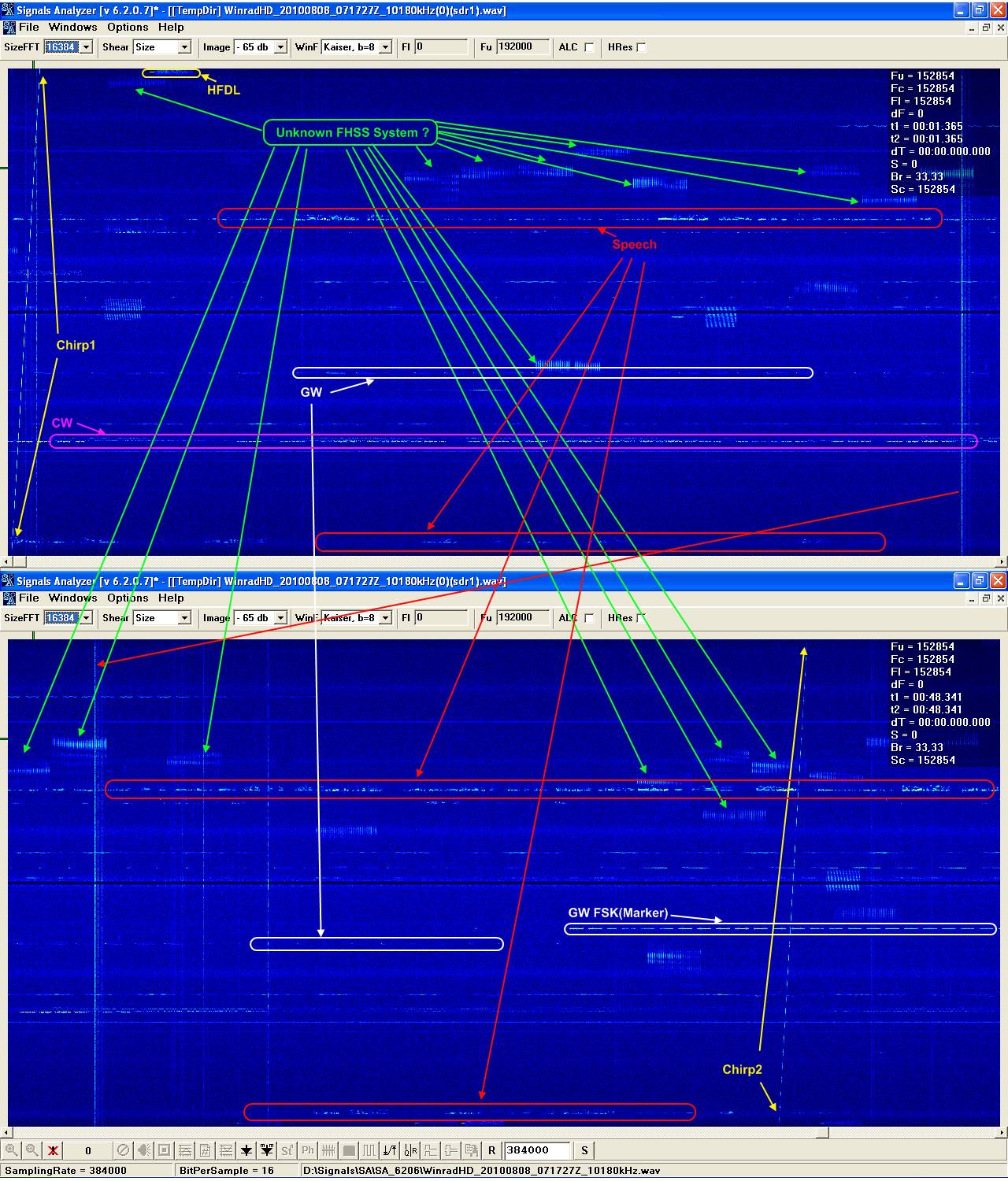
The very interesting signal, which record has been represented by Mike, appeared in UDXF conference.
The record itself, is ~2 minute I/Q file, with capacity 16 bits, the size of the file is nearby 80-90 mbyte.
Actually, there are many various signals in this record, we have marked some on the general spectrogram.

General view.


Presence of two chirps seemed very interesting to us. That has allowed to measure key parametres and to find out some curious nuances.


There is an interesting gaps(breaks), in the same positions, on two independent chirps.

In generall, the basic interest, certainly represents, not absolutely clear/understandable system, which is well visible on this spectrogram and designated on the general sonogram by green colour.

Unfortunately, on this record, it is impossible to tell precisely what width of a spectrum has this signal. Presumably it can be about 20 kHz. Nevertheless, it is well visible, that the signal has FHSS signs. It is also rather not difficult to receive key/basic parameters. It is well visible that the nature of impulses, practically in all bursts, is absolutely identical. That is strange enough, if the system is intended for real information transfer.

We are still have difficulty to classify this signal. Firstly, there is not enough data - the only one record. In the second, we didn't have similar records before. Besides, the subject of interest has too blurred limits(boundaries) and relatively weak level, plus it is liable to considerable selective fadings.

At the conference, also the other signal is discussed. The parameters of this signal, differ from the first signal, but both these signals have similar impulse nature, and close structure (an alternation of the small identical bursts). Probably, there are a lot of such signals in the air, all these signals can be different, but they are very interesting signals observe to.

четверг, 1 октября 2009 г.

UDXF Forum discussion:Unidentified signal on 8600.9kHz USB (France)‏


After analysis we identifed that signal. It is Globe Wireless OFDM Waveform.


The quantity of channels is well visible from the picture, there are 16 channeles. Not each analyzer is able to show it on such Signals. The matter is that GW has the very short CP and short enough body of the signal, it does not allow to distinguish channels by usual analyzers. Manipulation mode in the channels for GW is standardly PSK-4 (QPSK). Speed of manipulation approximately is 55-56 Hz.

The record is in mp3, althought *.wav format is the best for analysis. For the ones who want to know more about how to make a good record for analysis i post the link on our short article with easy steps "Record for the following analysis".

It will be usefull to read.

Thanks to UDXF forum for interesting discussion and UDXF members for the signals.

вторник, 25 августа 2009 г.

An example of the signal from UDXF forum's discussion


Unfortunately, the record is not qualitative: or the receiver is RX, or the recording devices are distorting the signal.

But nevertheless.


8 frequency channels with space between frequencies 300 Hz and speed of manipulation (Baud rate) in the channel 100 Hz.

Ofcourse, it is possible to spend deeper analysis, but we already have enough data(including width of the spectrum), what is enough for a reliable identification of the signal.

It is classed as Japanese Military 8 freq. The description of this signal is in our signal's base http://signals.radioscanner.ru/base/signal159/ .


понедельник, 24 августа 2009 г.

The small example: the signal from discussion in UDFX Group.

The marker of free channel of the sea coastal station SITOR from Turkey.