Показаны сообщения с ярлыком OFDM. Показать все сообщения

воскресенье, 16 октября 2011 г.

CROWD-36 (SERDOLIK) - OFDM mode

CROWD-36(SERDOLIK) - OFDM mode
Ch-34, Br-40, Sh-40, PSK-4, The OFDM without CP

Author: SergUA6 
Band Width ~1400 Hz
Baud Rate 40 Hz
n-Ary (PSK/MPSK) PSK-4
Count of Carriers 34
Step between carriers 40 Hz
Pilot tone(s) 393 Hz, this tone or pilot, or continue transmit data of zero in PSK-4 mode
RX mode SSB


Sonograms:
pic.1 General view


pic.2 Manipulation speed


pic.3 Detalization of the second channel


 Diagrams:
pic.4 The first channel in the fourth degree


 pic.5 Constellation of the first channel


CROWD-36 (SERDOLIK) - OFDM mode - is curious enough signal, where the principles of OFDM technologies usage  for formation of a various type of manipulations/modulations are perfectly shown. 


MFSK and OFDM segments are generated/formed absolutely equally, the difference is only in the form of used modulation, besides this OFDM signal has no cyclical prefix. Speed of manipulation is precisely equal to frequency space (step between frequencies) - that is the big rarity, and it is possibly linked with the fact, that initial synchronization is provided on the operation stage in MFSK a mode. 


The presence of pilot-tone or the continuous transmission of zero in PSK-4 mode is viewed In the second channel of OFDM segment, alghough i can't say definitely.


Though OFDM signals without CP  are very difficult for the analysis, in this record  it is even possible to define a manipulation mode in the first (lower) channel thus this channel is rather easily possible to select/mark this channel confidently enough, thanking presence of the pilot-tone in the second channel. 


Absence of the prefix allows to use as much as possible densely all the spectrum, with the maximum real speed that in this signal makes 34*40*2=2720 bps. If the second channel is really the pilot, then the maximum technical speed is slightly less - 2640 bps.

пятница, 7 октября 2011 г.

OFDM, COFDM: DRM+ (DRM-E)

DRM+ (DRM-E)
Ch - 213, PSK-4, Br - 400 Hz, Sh - 444.4(4) Hz, k = 1/9

Author: SergUA6 
Band Width ~95500 Hz
Baud Rate 400 Hz
n-Ary (PSK/MPSK) PSK-4
Count of Carriers 213
Step between carriers 444.4(4) Hz
ACF      100 ms
RX mode Source I/Q record


Sonograms:

pic.1 General view


pic.2 The main signal's parameters.


Diagrams:
pic.3 The constellation in the channel


pic.4 Detalization


Pictures:
pic.5 ACF of the signal.


DRM+(DRM-E) - DRM format for VHF broadcasting, it is intended to extrude the analogue decisions in this sphere. It posseses range of attractive advantages: the necessary band is about 95-96 kHz on the broadcast channel, the transmission till 4 of independed programs is possible in one channel.


The signal itself is the typical representative of OFDM tecnology. All the parameters are defined in SA easyly enough. The maximum technical speed for PSK-4 and 213 channeles is 170 kbit/sec. In reality, the real speed of data transmission is a bit lower (about 130-150 kbit/sec), at the expencse of usage of part of the channels and symbols as the pilot/service.


As far as i know, the prespective of this standard in Russia are *foggy* enough, this record sent by collegues from Europe.


среда, 13 июля 2011 г.

OFDM. COFDM: Rohde&Schwarz GN2130 digital voice modem

Rohde&Schwarz GN2130 digital voice modem
OFDM, Ch - 48, Sh - 56.25, Br - 44.4(4), QAM-16/PSK-4, k = 17/64

Author: SergUA6 
Band Width ~ 2700 Hz
Low Range ~ 360 Hz
Baud Rate 44.4(4) Hz
n-Ary (PSK/MPSK) Mixed QAM-16/PSK-4
Count of Carriers 48
Step between carriers 56.25 Hz
ACF Typical ~ 45 ms
RX mode  SSB


Sonorgams:

pic.1  General view


Diagrams:

pic.2 General quantity of the channels


pic.3 The constellation in the channel


R&S GN2130 - is the The voice modem, optionaly delivered to HF transceiver XK200 of R&S corporation. It is used for a speech transmission after conversions into a digital form, closing of the data by means of internal cryptoprocessor is possible. In this example, 48 channel OFDM signal is orginized, with standard enough parametres. 


Modulation in the channels is mixed QAM-16/PSK-4.  Features: it is necessary to mark presence of the auxiliary/pilot-symbols , in every second symbol through every one channel for synchronisation and customisation/fine tuning of the adaptive corrector the special signals are transmitted. Also there is a presence of the preamble with duration about 600 msec. Maximum common technical speed for QAM-16 is ~ 8533 bps.

пятница, 29 апреля 2011 г.

OFDM, COFDM: CIS-79, conditionaly name TANDEME

CIS-79, conditionaly name TANDEME
Ch-79, QAM-64, Sh-37.5, Br~30.476, k = 59/256
OFDM, COFDM

The signal is here. Send by YuriVR.

Author: SergUA6 
Band Width ~3000 Hz
Low Range ~350 Hz
Baud Rate ~30.476 Hz
n-Ary (PSK/MPSK) QAM-64 and PSK-8
Count of Carriers 79
Step between carriers 37.5 Hz
RX mode SSB

Sonograms:

pic.1 Generall view


 pic.2 Normal symbol and destroyed by distortions symbol


Diagrams:

pic.3 The constellation in the special/service channeles


pic.4 Full constellation of the channel


CIS-79, TANDEME - Russian native signal, which full analysis was realized by participants of  "power group"  of our forum. From singularities it is necessary to mark a preamble. This preamble isn't OFDM part, and represents an independent special fragment. Also usage in service channels of modulation PSK-8 is curious enough. The record completely corresponds to initial parameters of the signal, and thereupon rather explicitly can be studied in SA without special problems. Despite high quality of the material, there are destroyed symbols, which as are perfectly visible at the detailed review in SA, it is the result of an overload at signal's recording.

среда, 23 марта 2011 г.

Update SA to version 6.2.4.4

 
SA update to the version v 6.2.4.4 

We continue to increase SA power and abilities, we expand possibilities of OFDM module of the analyzer in this update.
 

1. In display of OFDM signal spectrum  small pedestal/platform in 10 pixels is added. It allows to see all line of channels current/investigated LU.

2. Possibility to display on phase planes only every second, the third etc. symbols  is added.

3. Possibility to shift/replace a start point is added during dynamic mapping. In a combination with the previous element, it allows to find out/study rather effectively various special channels/symbols in signals.
As an example there is one service channel of signal WinDrm is shown below.


For comparing it is shown as it looks/looked in old versions.


Important! The second and third points of updates, work only in a dynamic mode!

This update considerably expands analysis OFDM  signals, bringing it on qualitatively higher level.

Small manual on the technician of OFDM analysis  by means of current version SA are described in the article the Overview article (manual) about  the analysis of various OFDM signals in SA versions v 6.2.4.4

Good luck.

вторник, 15 февраля 2011 г.

OFDM, COFDM: CIS-128

CIS-128
Br~21, Sh~23.5, Ch-128 in use, total 129 - 1 as gap/off/skiped
OFDM, COFDM


Author: SergUA6
Band Width ~3000-3100 Hz
Low Range 470-500 Hz
Baud Rate ~21 Hz
n-Ary (PSK/MPSK) Mixed mode QAM-16 and PSK
Count of Carriers 129 - 1
Step between carriers ~23.5 Hz
ACF ~476-477 ms
RX mode SSB


Sonograms:

pic.1 General view

pic.2 Clock frequency of manipulation (classical method of recieveing)


Diagrams:
pic.3 The signal's detalization in OFDM module

pic.4 Detalization of the signal if OFDM module


pic.5 Detalization of the signal if OFDM module


Pictures:

pic.6 ACF of the signal

pic.7 CCF of two adjacent fragments with duration 250 ms


CIS-128 - is an interesting enough signal, though quality of the record is not so high. Nevertheless, rather easily it is possible to receive all main parameters in module OFDM. It is shown on the pictures.

It is very interesting that there is divergence ACF with a real state of affairs. ACF shows that there is a periodicity in 10 symbols in the signal. The detailed analysis in module OFDM allows to find out that every fifth symbol is specia l(synchro), and it is logical to expect, that ACF will be with the same period, but it is not so. This moment is easily specified with usage of CCF function. As it is shown on rice 7.

It is well visible that every fifth symbol special (synchro), but special (synchro) symbols different, and alternate through one. It also shows ACF as in this case the repetition period is really equal to 10 symbols.

CCF allows to receive more fine and exact structure, where it is displayed both the general period of special (synchro) symbols, which is equal 5 symbols (steps), and the period of separately even and odd symbols, which is equal already to 10 steps.

One more feature of this record which is well visible in dynamics - is the intensive use of modulation QAM-16 in the first half of the signal, and episodical/rare in the second part of the signal.

пятница, 3 сентября 2010 г.

OFDM, COFDM: CIS-59, Known as the "Ferrite", perhaps an experimental(inner) brand.

CIS-59, Known as "Ferrite", perhaps an experimental(inner) brand.
Ch-59, Br-40 Hz, Sh-50 Hz, QAM-64, k = 1/4 = 0.25


Author: SergUA6
Band Width ~3000 Hz
Low Range ~330 Hz
Baud Rate 40 Hz
n-Ary (PSK/MPSK) QAM-64
Count of Carriers 59
Step between carriers 50 Hz
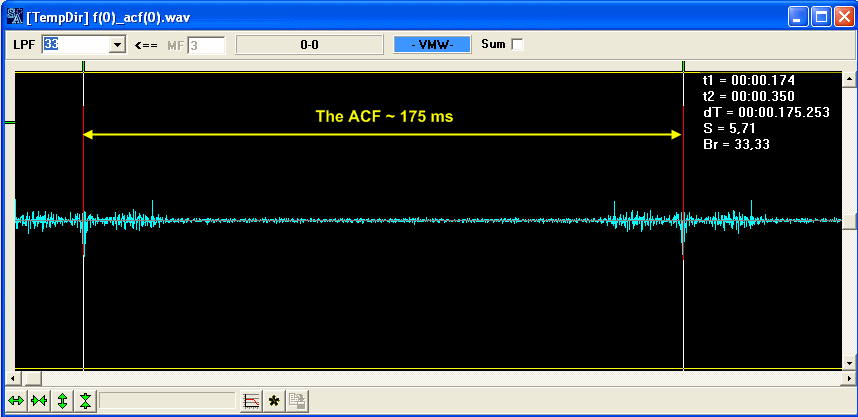
ACF ~175 ms
RX mode SSB

Sonograms

pic.1 Generall view

Diagrams
pic.2 Phase constellation in the channel

pic.3 Synchronization symbols (every 7th symbol)

Pictures
pic.4 ACF

CIS-59 "Ferrite" - The name "Ferrite" quite possibly is not wide known. We can suppose it is an internal trade mark of the manufacturer. The manufacturer is unknown (at least to me), but it is known that it is domestic (Russian) development . The record has an exellent quality, all parameters are easily defined in SA.

I would like to mark some features of this signal, these are:
  1. special symbols the synchronization/adaptations (every seventh symbol).
  2. the form of constellation QAM-64 is characteristic more likely for NATO signals, than for signals CIS.

The maximum technical speed = 59 (quantity channels) *40 (clock frequency of manipulation) *6 (quantity of bits in one position QAM-64) minus synchronization symbols, that makes 14160 - (14160/7) ~ approximately 12137 bps.

The signal is generated by A model.

The detailed information about models/types of OFDM is in article/update version SA update to version 6.1.2.7 & OCG update to version 1.0.2.7


четверг, 2 сентября 2010 г.

Parameters of OFDM signals. and SA update version 6.2.0.9

Update SA to version v 6.2.0.9


Function of obtaining an exact value of the clock frequency manipulation signals OFDM is added in OFDM module.


Of course it is only within reasonable limits, we are not talking about the absolute accuracy, since all measurements are statistical in nature, and there is always some error. Just this error, in our case, is very small.

Also we updated OCG program to version 1.2.0.9


Small calculator for getting basic parameters of OFDM with CP is added.

We also created an interesting article Parameters of OFDM signals.

This article contains:
  • an interesting information about parameters of OFDM signals
  • implementation of SA new version at analysis of OFDM signals
  • examples on the real signals from the air
  • features of OFDM analysis (like "magic" coefficient "k")
  • and small lessons how to analyze OFDM signals
We are very hope you will find it interesting and usefull.

понедельник, 21 июня 2010 г.

OFDM, COFDM: Link-11, Tadil-A, Alligator

Link-11, Tadil-A, Alligator
MIL-STD 188-203-1A, Sh-110, Br-75, Ch-14+1+Pilot, pi/4 DQPSK, k = 7/15 = 0.466(6)


Author: SergUA6
Band Width ~2400 Hz
Low Range ~500 Hz, shift is possible, recieved in SSB
Baud Rate 75 Hz in channel
n-Ary (PSK/MPSK) pi/4 DQPSK in he channel
Count of Carriers 14 frequency manipulation in the block + 1 channel + 1 pilot-tone
Step between carriers 110 Hz in the block, 550 among the block and one morePilot tone(s) 1 pilot tone ~550 Hz, shift is possible, recieved in SSB
RX mode SSB

Sonograms:
pic.1 Generall view

Diagrams:
pic.2 Graphical spectrum

Pictures:
pic.3 Structure of the short start and generall parameteres of the signal

pic.4 Constellation in the channel


Link-11, Tadil-A, Alligator - is not rare signal on the air. this signal is characteristic enough for ear. It can be easily identified, because similar stuff is hardly can be found. There are two sorts of such signal, with rather long burst as in the example and with the short one. Both sorts of this signal has identical parametres, except lengh, for LINK-11 short, it does not exceed 300 msec, and usually an order 80-100 msec. Technical speed makes 15*75*2 = 2250 bps.