пятница, 13 мая 2011 г.

Purple License.

Greetings!

Dear readers and SA users, we would like to inform you, that we have added new type of SA license - it is Purple License.


Often there is a necessity to acquire/get 7-12-15 or more SA licenses, for example for some educational institution or computer classes. For such cases we have added one more type of the license - Purple license. This license has no fixed amount of keys by default, the amount of keys should be specified and paid by user. The amount should not be less than 5 keys. We are hope, that this type of license will help to solve some questions concerning SA acquisition.

вторник, 3 мая 2011 г.

New Article: Perspectives of the analysis of OFDM signals with CP.

Perspectives of the analysis of OFDM signals with CP. 

As usual, we assume that reader possesses some basic knowledge concerning principles of formation OFDM, and the reader is acquainted with our previous articles, as terminology and the main ideas remain former. 

There are some general provisions. 

We already were being considered and showed in the previous articles, that at formation of OFDM signals the basic/main/key parameters are LS, LU and LG (CP), which are having dimensional samples. Basically, each one of these two parameters from these three (LS LU LG), unambiguously set the third parameter, as there is a simple correlation, namely: 

LS = LU + LG; 

We add one more, the dimensionless parameter, coefficient k = LG/LU or k = ((Sh/Br) - 1). This parameter allows to receive correct LS, LU and LG for specific conditions, besides k possesses mass of other remarkable properties, but it is beyond this article. 

In a general view the scheme of formation of OFDM signal with CP looks as follows: 


As we already considered, and I once again underline this moment, that there is no any Hertz and-or seconds! LS, LU and LG have at a stage of formation dimensionality of samples/samplings. We name it Fundamental/primary/key parameters of OFDM signal, these parameters are core of OFDM signal. All is equal to these parameters (samples), with what speed they will be transferred, needless to say, that transmission/transfer speed should be a constant.


As soon as some speed of following is given to samples (sampling rate of formation of OFDM signal OFDM), then earlier faceless values LS, LU and LG acquire/get dimensionality in Hertzs and-or seconds. But! They don't lose, and can't lose their main/fundamental properties. For example, as there was duration LS = 100, LU = 60 and LG (CP) = 40 samples, so it remains, irrespective of sampling rate.


There is one nuance in these transparent and logical enough conclusions. All what has been told above, concerns to so-called sampling rate of formation of OFDM signal.


In practice, to form a signal at once on operational frequency it is not convenient, and frequently it is not even possible. Normally, the signal should be formed on sampling rate Х, and further whole spectrum of the signal should be transferred on operational frequency Y. Thus, sampling rate X can't change duration LS, LU and LG, as it (sampling rate) is a consequence of existence of these parameters, and frequency of transfer Y can't destructively influence these parameters as it is not connected to them.


Let's sum up the told...


Full version of this article you may read here.


The arcitle contain examples on the real signals, schemes, detailed pictures, explanations and other interesting information.

пятница, 29 апреля 2011 г.

OFDM, COFDM: CIS-79, conditionaly name TANDEME

CIS-79, conditionaly name TANDEME
Ch-79, QAM-64, Sh-37.5, Br~30.476, k = 59/256
OFDM, COFDM

The signal is here. Send by YuriVR.

Author: SergUA6 
Band Width ~3000 Hz
Low Range ~350 Hz
Baud Rate ~30.476 Hz
n-Ary (PSK/MPSK) QAM-64 and PSK-8
Count of Carriers 79
Step between carriers 37.5 Hz
RX mode SSB

Sonograms:

pic.1 Generall view


 pic.2 Normal symbol and destroyed by distortions symbol


Diagrams:

pic.3 The constellation in the special/service channeles


pic.4 Full constellation of the channel


CIS-79, TANDEME - Russian native signal, which full analysis was realized by participants of  "power group"  of our forum. From singularities it is necessary to mark a preamble. This preamble isn't OFDM part, and represents an independent special fragment. Also usage in service channels of modulation PSK-8 is curious enough. The record completely corresponds to initial parameters of the signal, and thereupon rather explicitly can be studied in SA without special problems. Despite high quality of the material, there are destroyed symbols, which as are perfectly visible at the detailed review in SA, it is the result of an overload at signal's recording.

пятница, 15 апреля 2011 г.

Update SA to version 6.2.4.6

SA Update to version v 6.2.4.6

Support of 64 bit data with a floating point is added. 


The algorithm of operation of OFDM module had been essentially changed.

"One-dimensional" search of a correlative triangle(CT) which had been realized in the previous versions, possesses imperfection. The probability of detection/finding CT, depends on signal shift on/by frequency, and sometimes the algorithm is mistaken.

Problem is not in the fact that it happen rather rare, and in that, if the triangle hasn’t been found out there are no any warranties that the triangle really doesn't exist.

In the current version of OFDM module another algorithm of "two-dimensional" search (terminology belongs to our mathematic) is implemented. This algorithm provides much bigger guarantee of findings CT, and besides it has reserves for optimization. In spite of the fact that in the computing/calculating relation the new algorithm is much more resource-demanding than the previous one, the general speed of finding/detection CT, is increased in 6-7 and more times, especially it is noticeable on the big dimensionalities LS, for 600-800 samples and above


Possibility of relocation of the green marker through the keypad is added. It works only in a dynamic mode, as in the static mode there is no big sense to “walk” on channels.


Some utilitarian actions in OFDM module has been automatized, for example, in the current version the program tries to install CT in an optimal position independently. Accuracy of calculation of clock rate(Br) is increased.

Also work/operation of some separate functions and procedures is reconsidered/optimized both in OFDM module and in other modules.

As usual, except the described changes, a range of internal corrections is realized, errors found out by users has been fixed.

This update affects and changes a little bit the general scheme of actions at analysis OFDM. Though these changes are rather insignificant and directed on simplification of procedure of the analysis, nevertheless, we will provide the small article about an operation with the current version in the near future.  

Good Luck!


среда, 23 марта 2011 г.

Update SA to version 6.2.4.4

 
SA update to the version v 6.2.4.4 

We continue to increase SA power and abilities, we expand possibilities of OFDM module of the analyzer in this update.
 

1. In display of OFDM signal spectrum  small pedestal/platform in 10 pixels is added. It allows to see all line of channels current/investigated LU.

2. Possibility to display on phase planes only every second, the third etc. symbols  is added.

3. Possibility to shift/replace a start point is added during dynamic mapping. In a combination with the previous element, it allows to find out/study rather effectively various special channels/symbols in signals.
As an example there is one service channel of signal WinDrm is shown below.


For comparing it is shown as it looks/looked in old versions.


Important! The second and third points of updates, work only in a dynamic mode!

This update considerably expands analysis OFDM  signals, bringing it on qualitatively higher level.

Small manual on the technician of OFDM analysis  by means of current version SA are described in the article the Overview article (manual) about  the analysis of various OFDM signals in SA versions v 6.2.4.4

Good luck.

пятница, 4 марта 2011 г.

Examples of using MFSK demodulator in SA v 6.2.4.2

 Examples of using MFSK demodulator in SA v 6.2.4.2 


In this article, we will consider examples of usage of universal MFSK demodulator in SA version v 6.2.4.2 


Practically, any FSK/MFSK signal can be demodulated to a bit-stream in SA last versions. Here is, when we say "any" we mean, that there is nothing known about a signal initially. Also it is meant that necessity for obtaining/getting of the bit-stream can arise at any moment, on any signal, or any part of a signal. 


The Example. The record of an unknown system in a VHW band ~900 mHz. 


Step by step guide of main actions is shown below: 

Step 1. Select a necessary/interesting fragment of the signal and create a copy. 

Step 2. Select a necessary/interesting band of the signal and move it in a bottom. 

Step 3. The Main objective of the previous step is the reduction of sampling rate to an optimal value. Initial record has sampling rate 68 mHz, and it has sampling rate for the signal, which is interesting us with the full spectrum in ~ 180-190 kHz is absolutely superfluous. 

The mechanism of the abstract frequency conversion of sampling rate is built in SA, that is to us it doesn't matter which sampling rate will be specific, it is important that it would be optimal. It works as follows, and we had already wrote about it in one of updates. 


In the same way works the abstract shift of a signal by frequency. It is also doesn't matter to us which position the signal occupies, but it is important that it would be in optimal position by frequency on sonogram. 

Let’s come back to the signal. 

The full version of this guide-article you may read here.

понедельник, 28 февраля 2011 г.

Update SA to the version v 6.2.4.2

Update SA to the version v 6.2.4.2

In this update the range of problems found out by users has been solved.


1. The rigid/hard restriction on data size for calculation ACF and CCF is introduced.
 
The matter is that due various reasons, at the call of ACF and CCF functions SA user can casually push "Ok" in a situation, when the user hadn't supposed to do it, or the user wanted to push "Cancel" instead "Ok", and the hand itself has pushed other button. :)
 
In this version such situations are eliminated. The maximum data size for operation of function ACF makes 70 mbytes. For CCF, the maximum size of a fragment is about 50 mbytes. If these restrictions for someone are essential, please inform us about it (e-mail us), and we will solve this question.


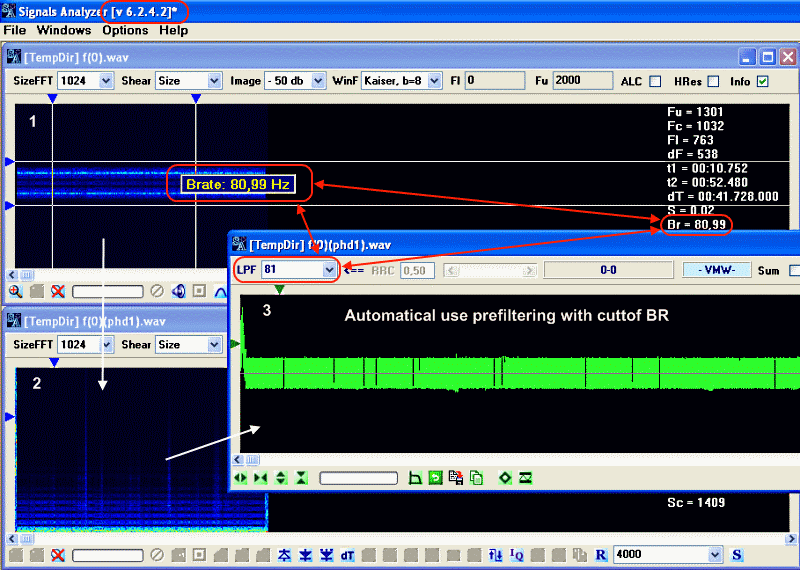
2. Very often, after the phase detector, the call of signals waveform module follows. In this version, if beforehand the value of clock frequency has been recieved by SA tools, then LPF filter is applied at once by default. Normally, in 99 % of cases, this is the standard action, which is just automated now.


As usual, except the described changes, a range of hardly noticeable, but important moments is fixed.


Good Luck!