пятница, 4 марта 2011 г.

Examples of using MFSK demodulator in SA v 6.2.4.2

 Examples of using MFSK demodulator in SA v 6.2.4.2 


In this article, we will consider examples of usage of universal MFSK demodulator in SA version v 6.2.4.2 


Practically, any FSK/MFSK signal can be demodulated to a bit-stream in SA last versions. Here is, when we say "any" we mean, that there is nothing known about a signal initially. Also it is meant that necessity for obtaining/getting of the bit-stream can arise at any moment, on any signal, or any part of a signal. 


The Example. The record of an unknown system in a VHW band ~900 mHz. 


Step by step guide of main actions is shown below: 

Step 1. Select a necessary/interesting fragment of the signal and create a copy. 

Step 2. Select a necessary/interesting band of the signal and move it in a bottom. 

Step 3. The Main objective of the previous step is the reduction of sampling rate to an optimal value. Initial record has sampling rate 68 mHz, and it has sampling rate for the signal, which is interesting us with the full spectrum in ~ 180-190 kHz is absolutely superfluous. 

The mechanism of the abstract frequency conversion of sampling rate is built in SA, that is to us it doesn't matter which sampling rate will be specific, it is important that it would be optimal. It works as follows, and we had already wrote about it in one of updates. 


In the same way works the abstract shift of a signal by frequency. It is also doesn't matter to us which position the signal occupies, but it is important that it would be in optimal position by frequency on sonogram. 

Let’s come back to the signal. 

The full version of this guide-article you may read here.

понедельник, 28 февраля 2011 г.

Update SA to the version v 6.2.4.2

Update SA to the version v 6.2.4.2

In this update the range of problems found out by users has been solved.


1. The rigid/hard restriction on data size for calculation ACF and CCF is introduced.
 
The matter is that due various reasons, at the call of ACF and CCF functions SA user can casually push "Ok" in a situation, when the user hadn't supposed to do it, or the user wanted to push "Cancel" instead "Ok", and the hand itself has pushed other button. :)
 
In this version such situations are eliminated. The maximum data size for operation of function ACF makes 70 mbytes. For CCF, the maximum size of a fragment is about 50 mbytes. If these restrictions for someone are essential, please inform us about it (e-mail us), and we will solve this question.


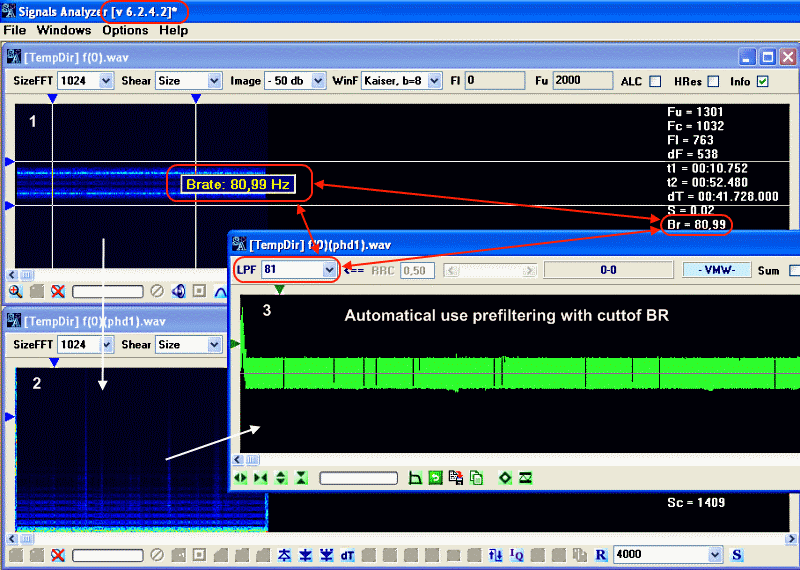
2. Very often, after the phase detector, the call of signals waveform module follows. In this version, if beforehand the value of clock frequency has been recieved by SA tools, then LPF filter is applied at once by default. Normally, in 99 % of cases, this is the standard action, which is just automated now.


As usual, except the described changes, a range of hardly noticeable, but important moments is fixed.


Good Luck!

воскресенье, 20 февраля 2011 г.

SA update to version v 6.2.3.8: Universal MFSK demodulator

SA update to version v 6.2.3.8

In this update, the pilot version of the general-purpose/universal demodulator MFSK is realized.


The demodulator supports to 256 levels (frequencies) of various MFSK signals. As an example: obtaining of a bit stream from the records Packet AX.25 and APCO-25 it is shown on the picture above. As FSK-2 it is special case of MFSK, the current extension of the module doesn't influence the previous possibilities, but only expands them.


Please pay attention on the allocation of levels of demodulation. The first and last levels, aren't restricted by the markers! Their area is stretched behind their limits, as it is shown below.


The bit stream can be presented in two variants.

The first variant is the symbol representation of levels recoded by default. In this case, the internal map of codings is used. 32 characters are supported standardly. It is favourable for using for FSK-2, MFSK-4,8,16 etc., that is, for rather few-channeled MFSK modes.

The second - obtaining/recieveing of the stream in the form of HEX-byte. Bytes in this case are partitioned/devided by the symbol-separator "x" (the Latin character "X" on the lower register).


As, the bit stream implies further processing anyway, we have refused an inverse mode. There is no big sense in an inverse mode, as an inverse can be received in any exterior viewer. Besides, we are planning to create our own special viewer of a bit streams.

Below you may view the practical example of operation of general-purpose/universal MFSK demodulator on the signal South African Navy.


Good luck!

вторник, 15 февраля 2011 г.

OFDM, COFDM: CIS-128

CIS-128
Br~21, Sh~23.5, Ch-128 in use, total 129 - 1 as gap/off/skiped
OFDM, COFDM


Author: SergUA6
Band Width ~3000-3100 Hz
Low Range 470-500 Hz
Baud Rate ~21 Hz
n-Ary (PSK/MPSK) Mixed mode QAM-16 and PSK
Count of Carriers 129 - 1
Step between carriers ~23.5 Hz
ACF ~476-477 ms
RX mode SSB


Sonograms:

pic.1 General view

pic.2 Clock frequency of manipulation (classical method of recieveing)


Diagrams:
pic.3 The signal's detalization in OFDM module

pic.4 Detalization of the signal if OFDM module


pic.5 Detalization of the signal if OFDM module


Pictures:

pic.6 ACF of the signal

pic.7 CCF of two adjacent fragments with duration 250 ms


CIS-128 - is an interesting enough signal, though quality of the record is not so high. Nevertheless, rather easily it is possible to receive all main parameters in module OFDM. It is shown on the pictures.

It is very interesting that there is divergence ACF with a real state of affairs. ACF shows that there is a periodicity in 10 symbols in the signal. The detailed analysis in module OFDM allows to find out that every fifth symbol is specia l(synchro), and it is logical to expect, that ACF will be with the same period, but it is not so. This moment is easily specified with usage of CCF function. As it is shown on rice 7.

It is well visible that every fifth symbol special (synchro), but special (synchro) symbols different, and alternate through one. It also shows ACF as in this case the repetition period is really equal to 10 symbols.

CCF allows to receive more fine and exact structure, where it is displayed both the general period of special (synchro) symbols, which is equal 5 symbols (steps), and the period of separately even and odd symbols, which is equal already to 10 steps.

One more feature of this record which is well visible in dynamics - is the intensive use of modulation QAM-16 in the first half of the signal, and episodical/rare in the second part of the signal.

суббота, 12 февраля 2011 г.

SA update to version v 6.2.3.6

SA update to version v 6.2.3.6

We have added a cross-correlation function (Cross-Correlation Funсtion- CCF) in this update.

In a difference from ACF, CCF function, in some cases, can provide more information about a signal or the selected fragment.


After CCF launching, the cross correlation of the selected fragment of a signal between V-markers and whole record is calculated. It is shown typical on the picture, and it is certainly far not just one example of CCF usage.

As it is not difficult to notice, the selected fragment, enters as a component into all units of the signal on the record, and the position of this part is precisely defined on peaks of CCF resmult. The maximum peak will correspond to position of an initial fragment, as correlation in this case is 100 %. It is problematic enough to find out this singularity by other methods.

As usual, some bugs, which has been found out by users are eliminated, a range of internal functional improvings is realized.

Good luck.

четверг, 13 января 2011 г.

Updating SA to the version v 6.2.3.4

Updating SA to the version v 6.2.3.4


Users find out two problems.


The first problem. Sometimes, at the call of WF viewer, in the opened window, the part of a nonexistent fragment of the signal is displayed, usually, in the end.


The second. After registration is done. At the start of already registered version, the registration window keep constantly appear at each program opening.


Both problems were being happen rare enough. The last problem, in general, had been found out only in one case.


Nevertheless, if the user will be sending the detailed, step-by-step mechanism of occurrence/occurrence of the problem, chances of the fast and successful decision are rather great.


In this update we have removed these two errors, and we have added the new abilty into SA palette of tools.


The ability to obtain/get the first derivative of any signal, which is loaded in SA, have being added. The competent combination of this possibility with other tools, in some cases, expands the analysis, allowing to receive considerably better results.


There is the example on the picture, which shows an application of the first derivative, for obtaining more accurate and clear ACF picture, after quadrature detector.

The first derivative in DSP, at the general case/image, is approximated well enough by a difference of the adjacent samples of the signal.

As a whole, the first derivative can be interpreted as UPF with the special characteristic. Repeated application of this function is equivalent to obtaining of high-order derivative. I have to notice, that in practice it is extremely rare occurences, as already the first derivative received by method of multiply function application, in strict mathematical sense is not fully correct.

The signal-envelope sometimes is very informative by itself, but presence of a constant component frequently masks/hides various features. Using of the first derivative of the signal's envelope as the material for analysis, can strongly help in such cases. As it is shown on the example.

Good Luck~

среда, 29 декабря 2010 г.

SA update to version v 6.2.3.3 : OFDM Module.

SA update to version v 6.2.3.3

Long enough time ago SA users SA had paid attention that the copy of the selected on the sonogram fragment visually looks shorter than the original. This interesting phenomenon, entirely linked with property of uncertainty of FFT transformation.


The matter is that transition from the time area into the frequency area, which provides FFT transformation, excludes possibility of exact definition of position of concrete frequency component by the time. FFT only "says" that the component is entering into the block, but where is the component located in the block is unknown.

It is the very old and standard problem. It has no exact decision, but we counted possible to lower a sharpness of this phenomenon. As the basic problems arise within the small blocks, when the resolution on time on
the sonograms is rather good.

This is realized in the current version.


We just make replacement of one problem by another. If in the old versions, copied by the sonogram fragment, physically had such duration which had been displayed at the moment of copying. That in the current version, the physical duration is longer than it is specified at copying.


We have considered possible to go on such exchange, for two reasons.

In the first, users confuses that the copied fragment visually looks shorter, and this situation demanded actions to regulate it.

In the second, the work on the sonogram, assumes visual perception, and it is better to see the copied fragment the way it has been selected, neglecting real accuracy. Even more so further it is necessary to work with the fragments in the area of the sonograms displaying.

The mode of a signal review has been added by the users offer.


The review is provided by FFT window with the size in 1024 counts. The primary goal of the mode it is to pass part of the signal with preamble or another problem segment (by having placed the start point in the necessary position), before the correlation triangle search will begin.

In the review mode, FFT window moves on the signal loaded in OFDM module, by the slider which is shown on the picture.

After key parameters of the signal are gotten, it is possible to define the detailed parameters of the preamble or other fragmen, by moving symbol-by-symbol backwards on the part passed earlier.

The detailed example on the real signal is described in the article OFDM analysis in SA version 6.2.3.3

Also the problems concerned users bug reports are removed.