пятница, 3 сентября 2010 г.

OFDM, COFDM: CIS-59, Known as the "Ferrite", perhaps an experimental(inner) brand.

CIS-59, Known as "Ferrite", perhaps an experimental(inner) brand.
Ch-59, Br-40 Hz, Sh-50 Hz, QAM-64, k = 1/4 = 0.25


Author: SergUA6
Band Width ~3000 Hz
Low Range ~330 Hz
Baud Rate 40 Hz
n-Ary (PSK/MPSK) QAM-64
Count of Carriers 59
Step between carriers 50 Hz
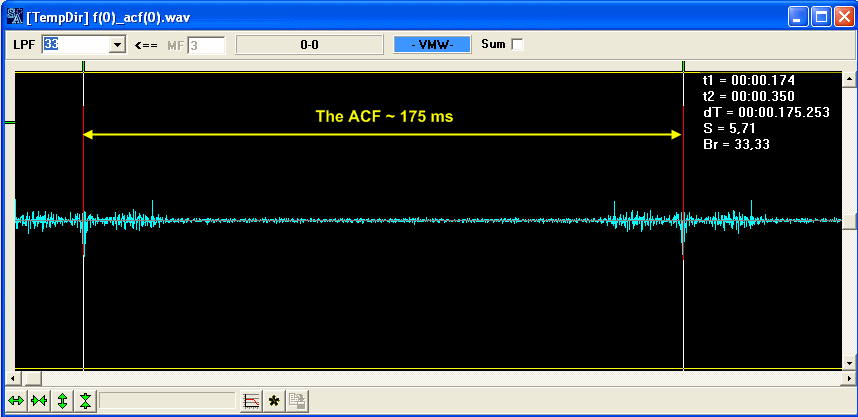
ACF ~175 ms
RX mode SSB

Sonograms

pic.1 Generall view

Diagrams
pic.2 Phase constellation in the channel

pic.3 Synchronization symbols (every 7th symbol)

Pictures
pic.4 ACF
CIS-59 "Ferrite" - The name "Ferrite" quite possibly is not wide known. We can suppose it is an internal trade mark of the manufacturer. The manufacturer is unknown (at least to me), but it is known that it is domestic (Russian) development . The record has an exellent quality, all parameters are easily defined in SA.

I would like to mark some features of this signal, these are:
  1. special symbols the synchronization/adaptations (every seventh symbol).
  2. the form of constellation QAM-64 is characteristic more likely for NATO signals, than for signals CIS.

The maximum technical speed = 59 (quantity channels) *40 (clock frequency of manipulation) *6 (quantity of bits in one position QAM-64) minus synchronization symbols, that makes 14160 - (14160/7) ~ approximately 12137 bps.

The signal is generated by A model.

The detailed information about models/types of OFDM is in article/update version SA update to version 6.1.2.7 & OCG update to version 1.0.2.7


четверг, 2 сентября 2010 г.

Parameters of OFDM signals. and SA update version 6.2.0.9

Update SA to version v 6.2.0.9


Function of obtaining an exact value of the clock frequency manipulation signals OFDM is added in OFDM module.


Of course it is only within reasonable limits, we are not talking about the absolute accuracy, since all measurements are statistical in nature, and there is always some error. Just this error, in our case, is very small.

Also we updated OCG program to version 1.2.0.9


Small calculator for getting basic parameters of OFDM with CP is added.

We also created an interesting article Parameters of OFDM signals.

This article contains:
  • an interesting information about parameters of OFDM signals
  • implementation of SA new version at analysis of OFDM signals
  • examples on the real signals from the air
  • features of OFDM analysis (like "magic" coefficient "k")
  • and small lessons how to analyze OFDM signals
We are very hope you will find it interesting and usefull.

пятница, 13 августа 2010 г.

Super DARN- is the interesting signal from UDXF discussion.

After some discussions, it became known, that the mysterious signal, about which we were spoken about in previous post is Super DARN (Finland).
Here is some details about this signal:

Super DARN
Author: SergUA6
Band Width ~5900-6000 Hz
Low Range hopping
RX mode source IF record

Sonograms:

pic.1 Generall view
pic.2 Detalization
pic.3 Detalization

Super DARN - there is developed enough international network for studying of an upper atmosphere and an ionosphere (Super Dual Auroral Radar Network) regions. The signal of one of radar of this network is represented in this case. The signal is curious enough, as possesses rather narrow spectrum of radiation, that is not characteristic for various probing systems. As a rule, spectrum's width of such systems, is located 20-80 kHz and higher limits. In generall, the measured parametres have relative/conditional character as can vary depending on tasks.

Many thanks to Leif Dehio for help with identification of the signal.

понедельник, 9 августа 2010 г.

An interesting signal from UDXF conference discussion.


The very interesting signal, which record has been represented by Mike, appeared in UDXF conference.
The record itself, is ~2 minute I/Q file, with capacity 16 bits, the size of the file is nearby 80-90 mbyte.
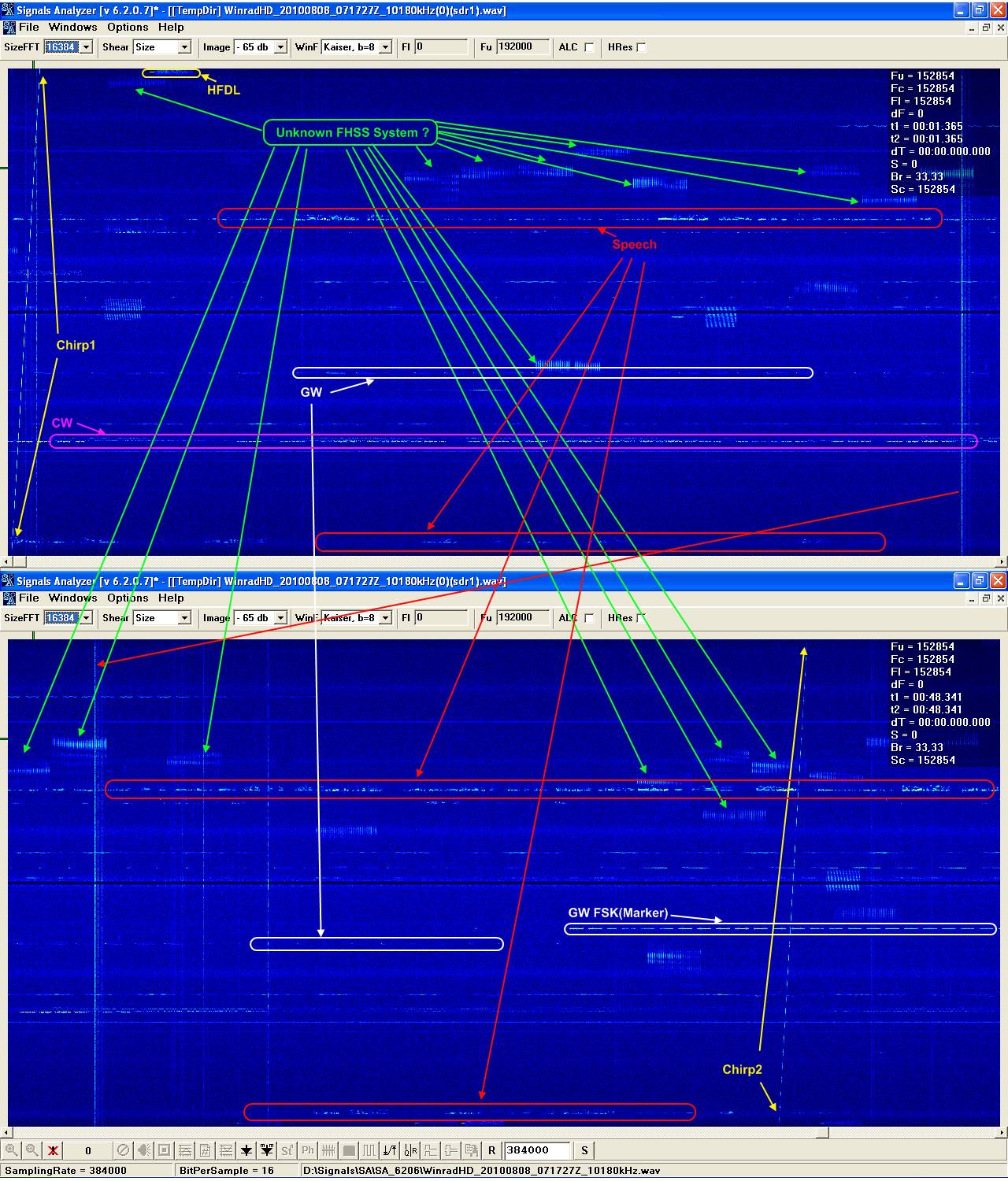
Actually, there are many various signals in this record, we have marked some on the general spectrogram.

General view.


Presence of two chirps seemed very interesting to us. That has allowed to measure key parametres and to find out some curious nuances.


There is an interesting gaps(breaks), in the same positions, on two independent chirps.

In generall, the basic interest, certainly represents, not absolutely clear/understandable system, which is well visible on this spectrogram and designated on the general sonogram by green colour.

Unfortunately, on this record, it is impossible to tell precisely what width of a spectrum has this signal. Presumably it can be about 20 kHz. Nevertheless, it is well visible, that the signal has FHSS signs. It is also rather not difficult to receive key/basic parameters. It is well visible that the nature of impulses, practically in all bursts, is absolutely identical. That is strange enough, if the system is intended for real information transfer.

We are still have difficulty to classify this signal. Firstly, there is not enough data - the only one record. In the second, we didn't have similar records before. Besides, the subject of interest has too blurred limits(boundaries) and relatively weak level, plus it is liable to considerable selective fadings.

At the conference, also the other signal is discussed. The parameters of this signal, differ from the first signal, but both these signals have similar impulse nature, and close structure (an alternation of the small identical bursts). Probably, there are a lot of such signals in the air, all these signals can be different, but they are very interesting signals observe to.

понедельник, 2 августа 2010 г.

PSK: INMARSAT Satellite

INMARSAT Satellite
INMARSAT AERO. OQPSK, Br-10500


Author: SergUA6
Band Width ~10500 Hz
Low Range ~750 Hz, in this example only!
Baud Rate 10500 Hz
n-Ary (PSK/MPSK) OQPSK, constellation looks as square PSK-8
Count of Carriers single mode
Carrier frequency 6079 Hz, in this example only!
ACF 500 ms
RX mode SSB

Sonograms:

pic.1 Generall view

pic.2 Baud rate
Diagrams:

pic.3 Typical characteristics of OQPSK and other half-modes.

pic.4 ACF
pic.5 View of the signal in VMW

Pictures:

pic.6 Phase constellations


INMARSAT AERO - INMARSAT is using wide enought line of different protocols. In this record, it is presumably AERO-H. The signal is very bright. All the parameteres of this signal can be easily determined.

четверг, 22 июля 2010 г.

Updating SA to the version v 6.2.0.7

Updating SA to the version v 6.2.0.7


Updating SA to the version v 6.2.0.7

It is regular updating, which includes fixing of the small errors and problems, which are not having basic value, but nevertheless demanding the decision.

new demo clip "the Review of the top ruler of tools" is added in section of demo of files. The top ruler answers basically for management of a display mode sonograms, and it is desirable to have full idea about possibilities which is in SA.

Good luck.

среда, 21 июля 2010 г.

PSK:TETRA - DMO, terminal to terminal connection

TETRA - DMO, terminal to terminal connection
Direct Mode Operation, Br-18000, pi/4 DQPSK


Author: SergUA6
Band Width ~25000-26000 Hz
Baud Rate 18000 Hz
n-Ary (PSK/MPSK) pi/4 DQPSK
Carrier frequency 15639 Hz, in this example only!
RX mode source I/Q record


Sonograms:
pic.1 Generall view

pic. Manipulation speed

pic.3 Getting of carrier frequency

Diagrams:

pic.4 Generall frame structure

Pictures:

pic.5 Constellation


TETRA - DMO, terminal to terminal connection - the mode of direct terminal (mobile stations, phones etc) connection of TETRA standard, without participation of base stations equipment.